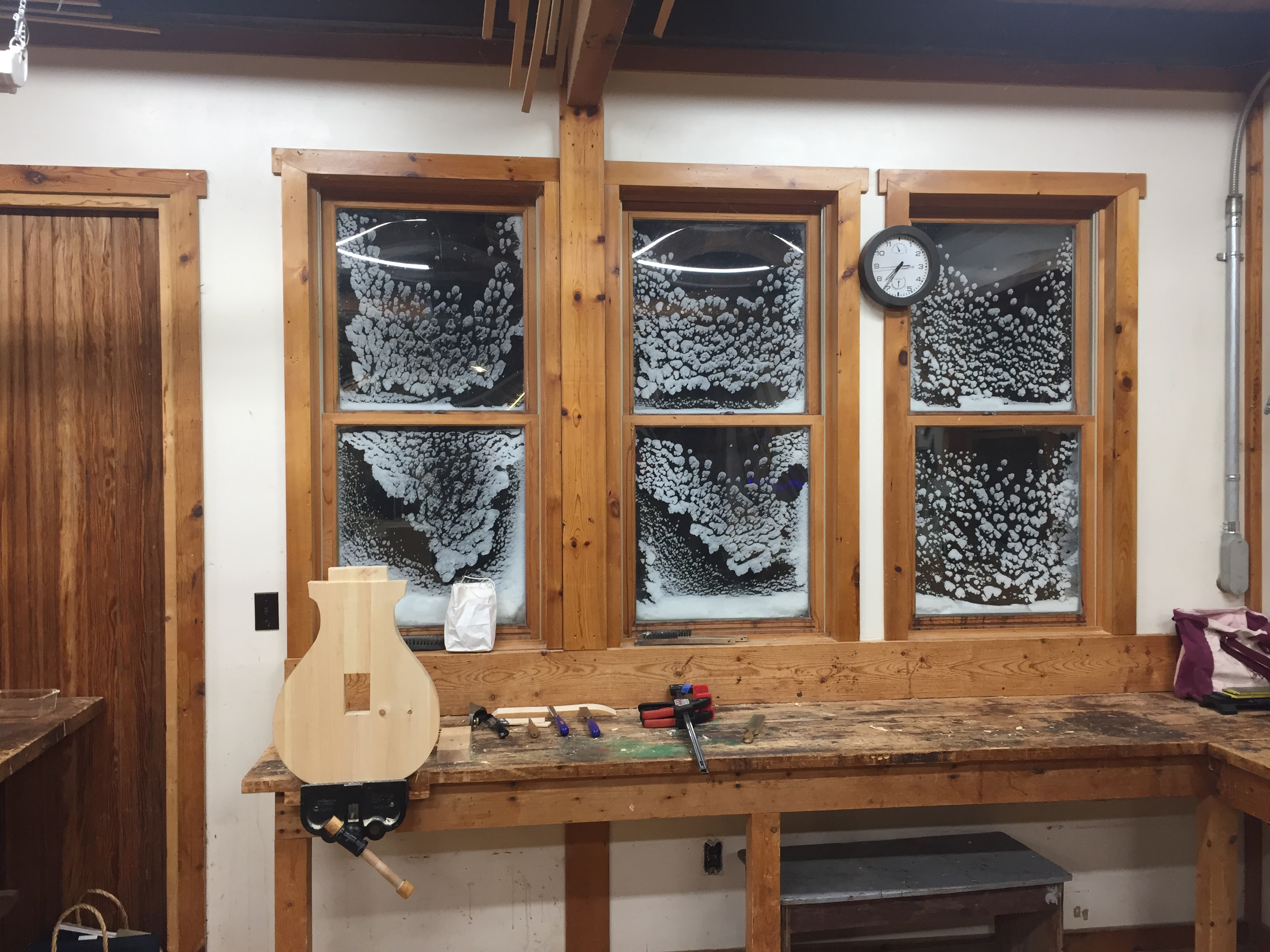
Most people who start woodworking buy more tools than they need. The standard advice — go slowly, buy quality over quantity — holds up, but it doesn't tell you which tools to actually start with. This article documents the core set used most often in Canadian community workshops and folk schools, along with what each piece does and the basic setup each requires before it's worth using.
The list below is drawn from observations at workshops in British Columbia, Ontario, and Nova Scotia. There is no universal answer, but there is a practical minimum that most instructors agree on.
The core set
Panel saw
A crosscut panel saw (around 550–600 mm, 7–8 teeth per inch) handles the majority of cuts needed on a first project. Western-style saws cut on the push stroke. Japanese-style saws cut on the pull stroke and tend to leave a thinner kerf, which some beginners find easier to control. Either type works. What matters more is that the teeth are sharp — a dull saw requires more force and produces less accurate cuts.
Many community workshops in Canada maintain a supply of loaner hand saws. Sharpening services for hand saws exist in most major cities; the cost is typically lower than purchasing a replacement.
Jack plane
A bench plane is used to flatten, smooth, and dimension stock — tasks that many beginners assign to sandpaper, with worse results and more time spent. A No. 5 jack plane (or a wooden equivalent of similar size) covers the most common tasks. Setting up a bench plane correctly — flattening the back of the blade, grinding and honing the bevel, seating the chip breaker close — takes about an hour the first time. After that, the tool works predictably.
The Canadian Woodworking magazine has published several accessible guides on plane setup that are worth reading before a first attempt.
Chisels
A set of four bevel-edge chisels (6 mm, 12 mm, 19 mm, and 25 mm) covers almost all basic joinery work. Chisels require the same sharpening attention as plane blades. Buying inexpensive chisels and sharpening them properly produces better results than buying premium chisels and leaving them dull.
At many skill-sharing events in Canada, sharpening is taught as its own session rather than as an add-on to another topic. This reflects how central the skill is — a session on joinery is harder to run productively if participants can't reliably sharpen their own tools.
Marking gauge and marking knife
A mortise gauge (with two adjustable pins) and a single-pin marking gauge between them handle the layout for most joints. A marking knife — a simple angled blade used to scribe cut lines — gives more precise layout than a pencil and is worth using from the start.
Combination square
A 300 mm combination square checks that edges are square, marks consistent distances from an edge, and can double as a depth gauge. Cheap combination squares often have inaccurate heads. A mid-range model from a hardware supplier is sufficient; an engineering square can be used to verify it.
Mallet
A wooden mallet is used with chisels and to close mortise-and-tenon joints. A 450–550 g round or rectangular lignum vitae or beech mallet is the most common type found in Canadian workshops. A rubber mallet is not a substitute — it absorbs force rather than transferring it cleanly.
What you do not need at the start
Router planes, shoulder planes, and rebate planes are useful but not essential at the beginner stage. A brace and bit is worth having if you work on older joinery or need to drill large holes without electricity, but a sharp chisel covers most of the same tasks in a first project. Power tools are outside the scope of this guide but are not necessary for any of the projects typically covered in introductory Canadian skill-sharing events.
Where to find tools in Canada
Antique and second-hand hand tools are available at estate sales, antique markets, and dedicated tool dealers in most provinces. Older Stanley, Record, and Preston planes are widely available and often represent better value than new imports in the same price range. The key check is whether the casting is cracked and whether the blade has enough metal left to sharpen. Lee Valley Tools operates retail locations across Canada and stocks a well-regarded own-brand line of hand tools with strong after-sale support.
Setting up a workspace
A solid workbench is more important than the tools on it. A bench that flexes or moves absorbs force that should go into the work. Community workshops address this by maintaining benches with proper vices and bench dogs. If you are setting up at home, a simple torsion-box bench built from construction lumber is a practical starting point — plans for this type of bench appear regularly in Canadian woodworking publications and at folk school open days.